On behalf of MIT Blueprint Labs, we would like to extend a heartfelt thank you for your engagement and support in 2025. This year, our team has studied crucial topics in education, health care, and the workforce. We’ve bridged the gap between this research and policy change through direct partnerships, policy initiatives, and events.
As we enter our fifteenth year of pursuing rigorous research and policy impact, we’re excited to reflect on the work we’ve done and continue building upon it.
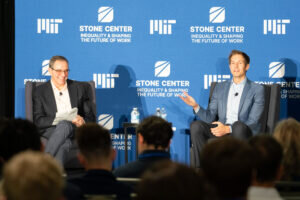
Blueprint Labs Co-Director David Autor and U.S. Congressman Jake Auchincloss speak at the Stone Center launch event. Photo by Bryce Vickmark.
School districts have long used standardized test scores to assess school quality, but in recent decades, some have also begun using surveys to measure school climate and socioemotional development. In a new working paper, Blueprint Labs scholars Joshua Angrist, Peter Hull, Russell Legate-Yang, Parag Pathak, and Christopher Walters partnered with New York City Public Schools to explore the links between school effects on test scores, student survey responses, and long-term student outcomes. Read the policy brief and the working paper to learn more.
In another working paper, Blueprint researchers examined the effects of K-12 enrollment systems. Large school districts increasingly use common applications, where students can apply to multiple schools on a single form. Recent research by Blueprint Director Parag Pathak, Research Associate Geoff Kocks, and co-author Christopher Avery examines the effects of Boston’s charter sector common application compared to other enrollment systems. Read the policy brief, the working paper, or a FutureEd write-up to learn more.
Existing literature on the employment effects of automation focuses on job tasks’ “exposure” to automating technology. New research from Blueprint Co-Director David Autor and Neil Thompson shows that technology’s effect on expertise also plays an important role. Automation (including AI) can make a job more or less “expert,” depending on the tasks it removes and/or creates. When a job becomes less expert, wages tend to fall, but employment increases. When a job becomes more expert, wages tend to increase, but employment decreases. Read the working paper to learn more.
Another recent working paper builds upon Blueprint researchers’ influential research on the impacts of China’s manufacturing growth in the early 2000s, known as the “China Shock.” The new research reveals that geographic places in the US that were hit hardest by Chinese import competition have bounced back economically, but the individuals who were working in manufacturing at the time of the shock have not. Read the working paper to learn more.


Blueprint’s Charter School Research Collaborative has worked to advance rigorous, actionable charter school research since its launch in 2023. This year, the Collaborative granted funds to sixteen research projects, including four projects that will build on work from previously funded pilot studies and proposal development projects. These projects study a wide range of topics, including literacy practices, special education, state-level charter school laws, and the long-term effects of charter schools across a wide variety of contexts.
Two years in, the Collaborative has begun to generate valuable knowledge. For example, a recent Blueprint Labs policy brief summarizes research on urban and nonurban Massachusetts charter schools’ effects on students’ postsecondary outcomes, and new research from grantees Adam Kho, Shelby Smith, and Ron Zimmer explores charter school performance during and after the COVID-19 pandemic. This fall, Blueprint Labs Executive Director Eryn Heying testified about Massachusetts charter schools’ effects before the Joint Committee on Education in Massachusetts.

The James M. and Cathleen D. Stone Center on Inequality and Shaping the Future of Work launched in 2025 within Blueprint Labs. The new Center represents an expansion of the work of the MIT Shaping the Future of Work Initiative, which launched in January 2024. The Stone Center analyzes the forces that contribute to growing income and wealth inequality through the erosion of job quality and labor market opportunities for workers without a college degree.
The Stone Center is committed to communicating research findings to a broad audience and informing policymakers. This year, the Center’s leadership published op-eds in prominent journals such as The Atlantic and The New York Times, presented their research findings over 40 times to academic and policy audiences—including for the World Bank and at the AI Action Summit in Paris—and released a mini-comic based on Power and Progress: Our Thousand-Year Struggle Over Technology and Prosperity, developed with the BU Visual Narrative MFA Program.

Since 2019, Blueprint Labs has facilitated the School Access and Quality Fellowship, a one-year program for education leaders focused on improving education equity. Through in-person events, webinars, and virtual challenge sessions, Fellows build a strong community and learn about research and best practices.
This spring, SAQ’s fifth iteration came to a close with a City Learning Visit in Chicago. In the fall, Blueprint admitted its sixth cohort of SAQ Fellows, which includes 20 education leaders who work in school districts, state agencies, charter school organizations, and non-profits nationwide. This year, Fellows will complete a new capstone project, committing to a project of their choosing that complements their work in enrollment and school performance.
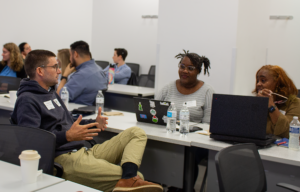
SAQ Fellows participate in small group discussions at the 2025 City Learning Visit.
Acemoglu, Daron, Tuomas Pekkarinen, Kjell Salvanes, and Matti Sarvimäki. “The Making of Social Democracy: The Economic and Electoral Consequences of Norway’s 1936 Folk School Reform.” Journal of the European Economic Association 23(1) (February 2025): 119–158.
Agarwal, Nikhil, Charles Hodgson, and Paulo Somaini. “Choices and Outcomes in Assignment Mechanisms: The Allocation of Deceased Donor Kidneys.” Econometrica 93(2) (March 2025): 395–438.
Angrist, Joshua, Carol Gao, Peter Hull, and Robert Yeh. “Instrumental Variables in Randomized Trials.” NEJM Evidence 4(4) (March 2025).
Cohodes, Sarah, Sean Corcoran, Jennifer Jennings, and Carolyn Sattin-Bajaj. “When do Informational Interventions Work? Experimental Evidence from New York City High School Choice.” Educational Evaluation and Policy Analysis 47(1) (March 2025): 208–236.
Corradini, Viola, Lorenzo Lagos, and Garima Sharma. “Collective Bargaining for Women: How Unions Can Create Female-Friendly Jobs.” The Quarterly Journal of Economics 140(3) (May 2025): 2053–2105.
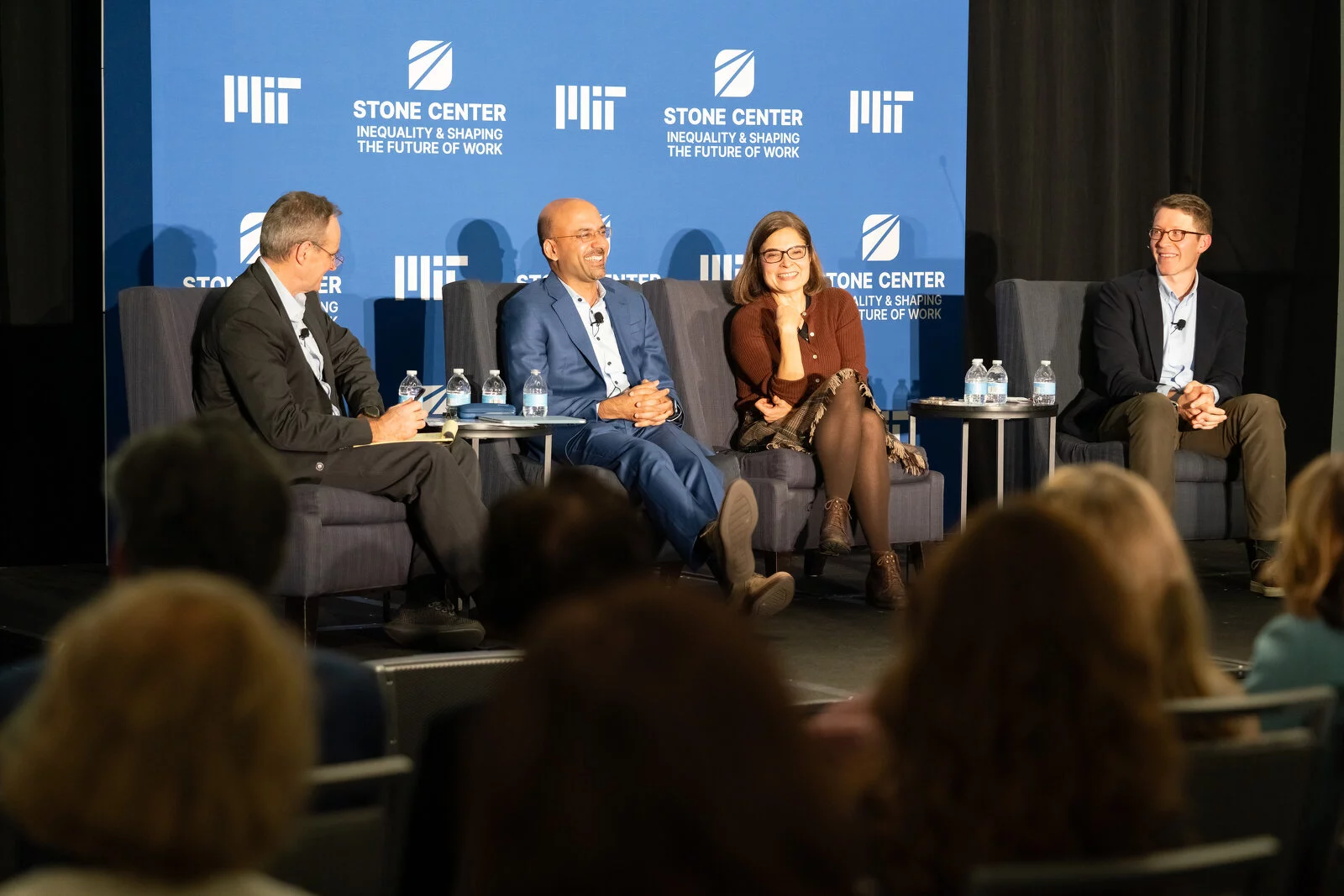
The James M. and Cathleen D. Stone Center on Inequality and Shaping the Future of Work celebrated its official launch on November 3, 2025. The half-day launch event brought together interdisciplinary scholars, policymakers, and practitioners to explore critical questions about wealth inequality, pro-worker AI, liberal democracy, and the future of work. Watch the recordings or read an event recap.
In total, the Stone Center (previously the Shaping the Future of Work Initiative) organized 9 events that drew over 900 participants in 2025. These events included a public symposium on Aligning Innovation and Equity in the Digital Economy; an academic “micro-conference” featuring presentations of cutting-edge economics research; and multiple book talks co-hosted with the MIT Sloan School of Management and the MIT Schwarzman College of Computing, including Arvind Narayanan on AI Snake Oil and Susan Stokes on The Backsliders: Why Leaders Undermine Their Own Democracies.
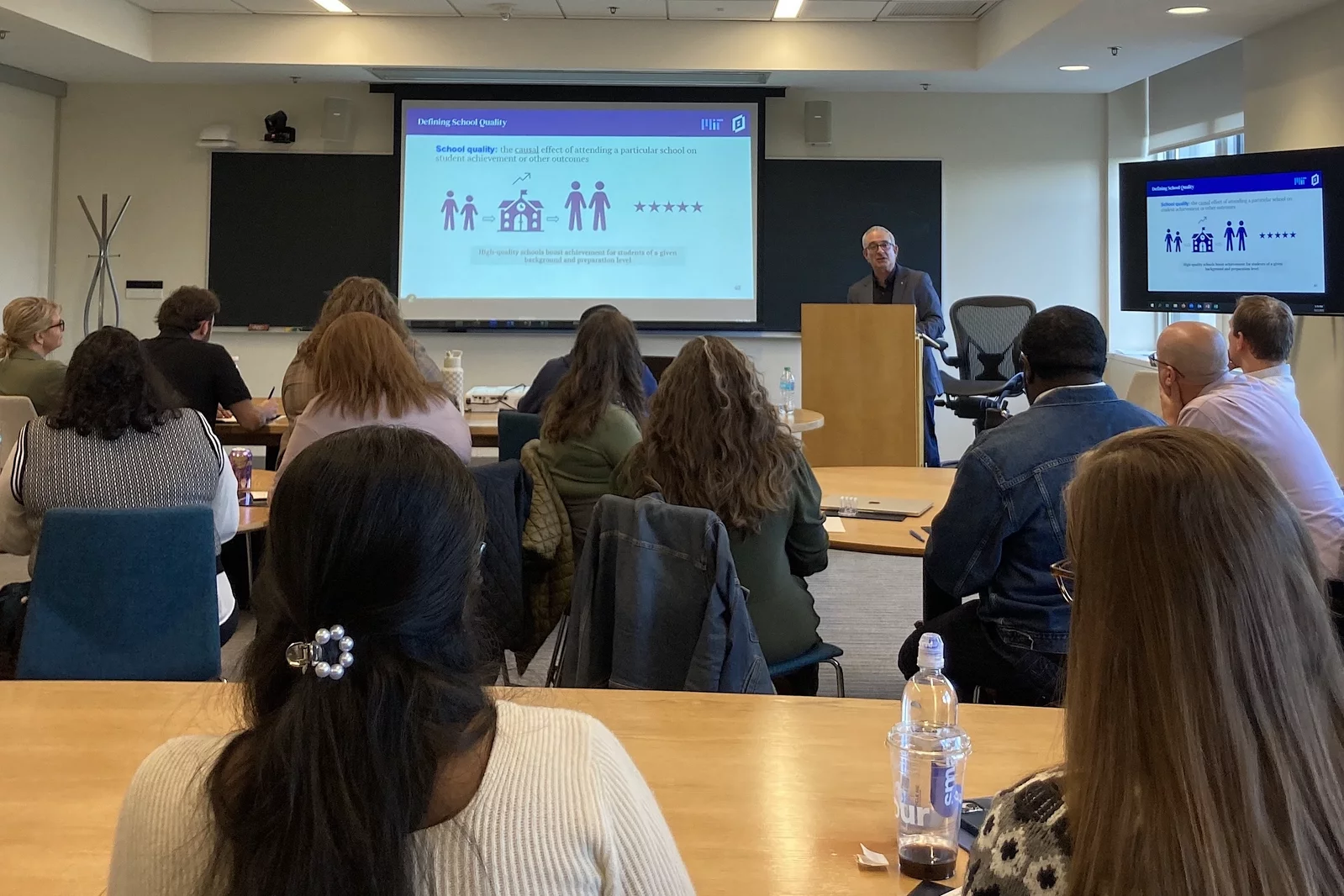
This year, Blueprint hosted events that closed and welcomed its fifth and sixth cohorts of School Access and Quality Fellows. In May 2025, Blueprint hosted the City Learning Visit in Chicago, where the fifth cohort of Fellows convened to learn about the city’s enrollment systems and practices. In October 2025, the next cohort of Fellows traveled to Boston for the sixth SAQ kickoff, where they learned about enrollment and school performance from researchers and policymakers. Read about the kickoff in our recent blog post.
Blueprint Labs will host several events in 2026. On January 27, 2026, the Stone Center will host a public symposium on Why Wealth Inequality Matters. Later this spring, Blueprint will host a school quality measures conference and a Charter School Research Collaborative convening where researchers, practitioners, policymakers, and funders will meet to share new findings and discuss policy implications. The Charter School Research Collaborative will also close its fifth request for proposals on February 5, 2026.
We are excited to release more innovative research and further our policy impact in 2026. Sign up here to receive updates on Blueprint’s work.
Subscribe for Updates

