


On March 12 and 13, 2026, Blueprint convened dozens of participants to discuss clear, equitable, and accurate measures of school performance at the 2026 School Quality Measurement Conference.
A Shifting School Quality Measurement Landscape
In recent decades, the school quality measurement landscape has transformed, influenced by factors ranging from the 2015 Every Student Succeeds Act to the pandemic. Now, as the federal government commits to “returning education to the states,” state and local governments may have more room to experiment with their school performance systems. Amid these changes, it’s more important than ever to prioritize school quality measures that accurately reflect a school’s impact on its students, so that families, educators, and policymakers can make informed, evidence-based decisions.
On March 12 and 13, Blueprint Labs held the 2026 School Quality Measurement (SQM) Conference, a two-day event that aimed to equip policymakers, practitioners, funders, and the research community with rigorous evidence on school quality measurement. Throughout the conference, researchers and practitioners led presentations, panels, and discussions that highlighted the latest research and best practices surrounding school performance measurement. Stakeholders from across the nation gathered to discuss how to use evidence to make policy decisions and transform accountability systems.
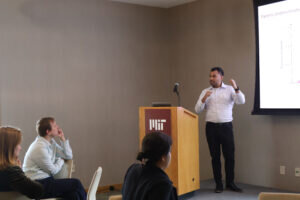
Chris Campos presents at the 2026 SQM Conference.
Learning from Research
Blueprint Labs researchers have studied school performance measurement for over a decade. At the beginning of this spring’s conference, Blueprint Labs Director and Nobel Prize winner Joshua Angrist described Blueprint’s approach to the problem of school quality measurement. He discussed Blueprint’s causal research and the importance of controlling for selection bias, which occurs when external factors like a student population’s income or race influence school quality measures.
Angrist also summarized Blueprint’s research on race and school quality measurement. The study shows that although race is unconnected to a school’s causal impact on student achievement, levels measures—measures of performance at a given point in time, like achievement and proficiency rates—are highly correlated with race. However, growth measures—which focus on students’ improvement over time—are less biased by student background and predict a school’s impact on student learning much more accurately.
On the second day of the conference, Blueprint Labs Faculty Affiliate Peter Hull and Predoctoral Researcher Fatima Djalalova shared recent Blueprint Labs research that explores the links between schools’ effects on test scores, student survey responses, and longer-term student outcomes in New York City. Surveys better predict schools’ graduation rates, whereas test scores better predict college enrollment and persistence rates.
Blueprint Labs Faculty Affiliate Chris Campos built on these discussions by sharing his study of how families make decisions based on school quality information. Families provided with school quality information send their students to higher-quality schools, improving student outcomes. Social interactions play a critical role in family decision-making.
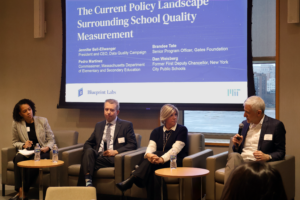
Brandee Tate, Pedro Martinez, Jennifer Bell-Ellwanger, and Dan Weisberg speak on a panel.
School Quality Measurement in Practice
How can we translate these valuable research insights into policy and practice? Throughout the conference, leaders in education provided valuable perspectives on communicating school quality measurement to families, schools, and other stakeholders.
On the first day of the conference, Brandee Tate, Senior Program Officer at the Gates Foundation, facilitated a panel discussion of the school quality measurement policy landscape, which included President & CEO of the Data Quality Campaign Jennifer Bell-Ellwanger, MA Department of Elementary and Secondary Education Commissioner Pedro Martinez, and former First Deputy Chancellor of New York City Public Schools Dan Weisberg. The panelists discussed providing school quality measures that are accurate yet comprehensible and balancing qualitative and quantitative measures, including measures of career readiness, an increasing focus for students and families. They emphasized the importance of authentic community engagement. Bell-Ellwanger pointed out that “data is not destiny”—she noted that school quality indicators are policy decisions and therefore reflect a jurisdiction’s priorities.
Throughout the conference, Eric Ashton from New York City Public Schools, Chris Wohn from Baltimore City Public Schools, Kevin Shallcross from Chicago Public Schools, and Pamela Wong from Denver Public Schools described what school performance measurement looks like in their districts. Many common themes emerged, including the challenge of balancing the different purposes of school quality measurement, which must inform family decisions as well as school accountability and feedback.
Looking Forward
At the end of the event, attendees had a final chance to discuss their takeaways from the conference. They discussed what they’d learned from research—for example, that it’s important to emphasize measures of growth and that providing enough families with the right information does shift their decision-making. We hope that this conversation sparked ideas and fostered relationships that the event attendees will carry forward in their work.