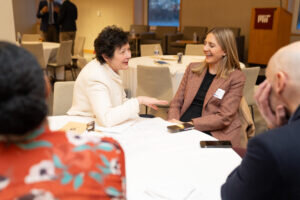
At the 2026 Charter School Research Collaborative Conference in April, Blueprint Labs convened researchers, practitioners, policymakers, and funders to share early insights from research and reflect on the first two years of the Collaborative.
Expanding Charter School Knowledge
Charter schools have grown significantly in recent decades, enrolling 7% of all US public school students in 2021, up from 4% in 2010. Existing research shows that charter schools—particularly those in urban settings—boost students’ test scores and college enrollment. However, less research has examined topics such as long-term and non-test-score outcomes, charters’ impacts over time and across different regions, and the practices that drive success.
In November 2023, Blueprint Labs launched the Charter School Research Collaborative to advance rigorous, actionable research to close these gaps in charter school knowledge. The Collaborative disseminates funds to researchers nationwide, conducts in-house research, and facilitates connections between charter school practitioners, policymakers, researchers, and other stakeholders to bridge the gap between research and policy impact. This year’s Charter School Research Collaborative Conference convened key stakeholders to reflect on the Collaborative’s first two years, explore emerging findings, and develop strategies to translate research into policy change.

Early Insights from Charter Collaborative Research
During the Charter Collaborative Conference, Blueprint Labs grantees shared preliminary findings from their charter school research. Chris Torres shared early research on the factors that explain Massachusetts charter schools’ positive impacts on college-going, and John Singleton presented preliminary work that delves into Texas charters’ impacts on neighboring traditional public schools. Matteo Magnaricotte shared early insights from a study of high-dosage tutoring’s effects on charter school students in New Mexico. Evidence from their randomized controlled trial suggests that students who receive tutoring learn more math than those who do not. Charter school students who received tutoring learned 29% more, similar to the effect on traditional public school students.
Blueprint Labs Director Joshua Angrist also presented early insights from Blueprint’s in-house charter school research. A study of Massachusetts schools shows that charter school performance has varied over the last fifteen years, with positive effects from the early 2010s declining from 2015 to 2019, before rebounding in the wake of the COVID-19 pandemic.
Blueprint’s preliminary research has identified several standout charter schools with consistent, positive effects on student outcomes, including Noble Schools, Bridge Boston, and Brooke Charter Schools. Leaders from those schools spoke at the conference about their efforts to improve student outcomes. During a panel discussion with Angrist on the first night of the conference, leaders from Noble Schools and Bridge Boston highlighted the importance of academic accountability and coherence—connecting consistent learning goals across all programming—in their students’ success.

Putting Preliminary Research into Perspective
Several charter school leaders, policymakers, and other practitioners spoke on panels throughout the conference, responding to early research and sharing their perspectives on the charter school landscape.
Practitioners showed enthusiasm about the Collaborative’s early insights. In particular, they’re excited to see work that focuses on understanding charters’ effects on college-going and graduation, studies that examine practices to combat post-pandemic learning loss, and research on charters’ effects on neighboring communities. Understanding whether charter schools can help “all boats rise” is critical to policymakers, practitioners, and funders.
Policymakers and practitioners also discussed the pressing questions that remain understudied. Authorizers need evidence to guide effective school approvals and closures, and stakeholders want to better understand which types of charter schools are most effective. Understanding charter schools’ long-term effects remains top of mind.
Several new topics of interest have emerged in recent years, such as private school vouchers and the role of AI. Attendees at the conference debated these topics, agreeing that rigorous research will play a critical role. Above all, attendees emphasized that research should focus on student outcomes. Karega Rausch, President and CEO of the National Association of Charter School Authorizers (NACSA), stated: “It’s about student outcomes. It always has been, should have been, and will need to be more than ever in the future.”

What Comes Next for Our Research?
One of the Charter Collaborative’s primary goals is to use rigorous research to generate policy impact. Several sessions at the conference delved into this topic. Raj Chetty, Professor of Economics at Harvard University and Director of Opportunity Insights, presented his approach to translating research to policy impact in the field of economic mobility. He highlighted the importance of working with local policymakers, communicating empirical research clearly, and disseminating new work deliberately.
Small-group discussions gave all conference attendees a chance to share early insights from research and practitioner perspectives, and to discuss how they can implement learnings from the conference in their own work. Speakers and attendees emphasized the importance of close collaboration among researchers and practitioners. Moving forward, the Charter School Research Collaborative will continue to learn from our partners and share our research widely, working to bridge the gap between research, policy, and practice.
Interested in getting involved? Learn more about the Charter Collaborative here, and read about our funded research here.